
What Crazy Time Strategy Can and Cannot Do
Crazy Time is a game of independent events. Every spin is resolved by a certified Random Number Generator that does not use previous outcomes. The wheel does not have memory, does not run hot or cold, and does not owe you a bonus after a drought. Any strategy that depends on predicting the next spin is not a strategy — it is a misunderstanding of how the RNG works.
What strategy can do is three things. First, it can reduce your average cost per hour by choosing bets with the highest RTP. Second, it can extend your session time by reducing variance. Third, it can match your actual behavior to your actual risk tolerance — so you do not end up playing a bonus-hunting strategy with a Number 1 bankroll.
What strategy cannot do is change the house edge. The RTP of Number 1 is 96.08% and stays 96.08% regardless of how you sequence your bets. Over enough spins, expected return is the RTP multiplied by total wagered. Longer sessions mean larger total wagered, which means more money flowing to the house — not more money flowing to you.
Best Bets by RTP — The Full Table
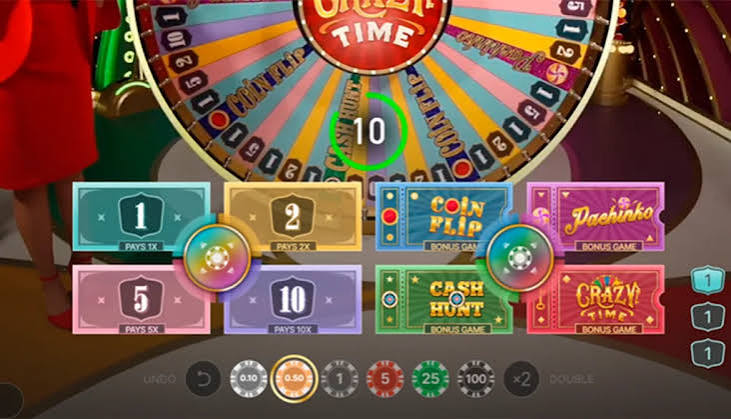
Crazy Time does not have one RTP. Each bet type has its own return, and the spread between best and worst is over 1.6 percentage points. The table below lists every bet type with its RTP, house edge, and trigger frequency per spin. This is the single most important reference for any Crazy Time strategy.
| Bet Type | RTP | House Edge | Trigger Frequency |
|---|---|---|---|
| Number 1 | 96.08% | 3.92% | 38.89% (21 of 54) |
| Number 2 | 95.95% | 4.05% | 24.07% (13 of 54) |
| Number 5 | 95.78% | 4.22% | 12.96% (7 of 54) |
| Number 10 | 95.73% | 4.27% | 7.41% (4 of 54) |
| Coin Flip | 95.70% | 4.30% | 7.41% (4 of 54) |
| Cash Hunt | 95.27% | 4.73% | 3.70% (2 of 54) |
| Crazy Time World | 94.41% | 5.59% | 1.85% (1 of 54) |
| Pachinko | 94.33% | 5.67% | 3.70% (2 of 54) |
Two conclusions follow. First, the best bet (Number 1) has a house edge of 3.92% — roughly eight times the edge on a well-played blackjack table. Second, the exciting bets are the expensive ones. Every bonus segment sits at the bottom of the RTP table, and the bonus with the highest ceiling (Crazy Time World at 20,000x) has the second-lowest RTP.
Strategy 1 — The Number 1 Play
The Number 1 play is the simplest strategy and the only one the math clearly supports for session longevity. You bet the same amount on Number 1 every round, and you do not bet anything else. No bonus segments, no side bets, no chasing.
What the math says: a $1 bet on Number 1 has an expected value of $0.9608 per spin. Over 100 spins, expected loss is $3.92. Over 500 spins, expected loss is $19.60. That is the cost of playing. Compared to bonus chasing, where the expected loss over the same number of spins is roughly 50% higher per dollar wagered, the Number 1 play is the cheapest way to spend time at the table.
What the strategy does not give you: large swings, bonus-round excitement, and the possibility of a five-figure multiplier. Number 1 pays even money. A $1 bet returns $2 when it hits. That is the ceiling. Players who want the bonus action should not use this strategy — they should accept the higher cost and choose a different one.
Practical bankroll guidance: at $1 per spin and a $100 bankroll, the Number 1 play survives roughly 100 spins before the expected loss clears the balance. Variance means actual results will differ — you might last 200 spins or bust in 50 — but the average is around 100.
Strategy 2 — The Bonus Hunter Spread
The bonus hunter strategy concentrates bets on the four bonus segments. The most common version is betting equal amounts on Coin Flip, Cash Hunt, Pachinko, and Crazy Time World every round, for a total of $4 per round at $1 per segment.
What the math says: each bonus bet has its own RTP, ranging from 94.33% to 95.70%. The combined RTP of the four-segment spread is roughly 95.08% per dollar wagered. That is 1 percentage point lower than the Number 1 play, which means the expected loss over the same total wagered is roughly 25% higher. The upside: bonus rounds carry multiplier ceilings from 100x (Coin Flip) to 20,000x (Crazy Time World).
What the strategy does not give you: session longevity. At $4 per round, a $100 bankroll survives roughly 25 to 30 rounds before the expected loss clears the balance — around 20 minutes of play. The variance is high. You might hit a Cash Hunt 500x on round 5 and triple the bankroll, or you might go 40 rounds without a single bonus and bust completely. Both outcomes are within normal variance.
The bonus hunter strategy is legitimate. It is a lottery ticket approach with a live host. The mistake is treating it as a value play — it is not. The RTP is lower than Number 1, the variance is higher, and the expected loss per hour is greater. Players who choose it should know they are paying for the ceiling.
Strategy 3 — The Balanced Approach
The balanced approach mixes a base bet on a number segment with smaller bets on one or two bonus segments. The most common version is betting $2 on Number 2 and $1 on Coin Flip each round. Total $3 per round.
What the math says: the combined RTP depends on the exact mix. A 2:1 split between Number 2 (95.95%) and Coin Flip (95.70%) produces a weighted RTP of roughly 95.87%. That is lower than the pure Number 1 play but higher than the bonus hunter spread. The variance is in between: less than pure bonus chasing, more than pure Number 1.
What the strategy gives you: some bonus action without fully abandoning the number RTP. Coin Flip is the most frequent bonus at 7.41% per spin, so a Coin Flip bet produces a bonus round roughly once every 13 or 14 spins. Cash Hunt, Pachinko, and Crazy Time World are less frequent but carry higher ceilings if you add them.
The balanced approach is the most common strategy for intermediate players. It is not mathematically optimal — the pure Number 1 play has higher RTP — but it is emotionally sustainable. Players who would quit the Number 1 play out of boredom can play the balanced approach for three times as long before the house edge clears their bankroll.

Why Martingale Fails on Crazy Time
Martingale is the classic doubling strategy: bet $1, if you lose double to $2, if you lose double to $4, and so on until you win, then reset. In a game with even-money payouts and no table limits, it theoretically guarantees a profit. In Crazy Time, it fails for three reasons.
First, bonus segments trigger too rarely. If you Martingale on Cash Hunt, which triggers on 3.70% of spins, you can go 30 or 40 spins without a single hit. Doubling from $1 across 30 losses requires a bankroll of over $1 billion. The math is not close.
Second, table limits exist. Every casino caps the maximum bet per segment, usually between $1,000 and $5,000. Even if you had an infinite bankroll, the table limit would stop the progression after ten or eleven doublings. At that point you are either all-in or capped.
Third, the house edge applies to every bet. Martingale does not change the RTP. Over enough spins, the expected loss is the same as flat betting — but the variance is much higher. Players using Martingale on Crazy Time tend to bust faster, not slower, because the increasing stake sizes accelerate the exposure to the house edge.
Martingale on Number 1 is slightly more viable because Number 1 hits 38.89% of the time, so losing streaks are shorter on average. But "slightly more viable" is not the same as "profitable." The expected return over 1000 spins is still negative, and the bankroll requirements still explode during a typical losing streak of 10 or 12 spins.
Bankroll Management — How Much You Actually Need
Bankroll sizing depends on your strategy. The table below shows the bankroll required to survive a session of 100 spins at different bet levels and strategies.
| Strategy | Bet Per Round | Bankroll for 100 Spins | Expected Loss |
|---|---|---|---|
| Number 1 only | $1 | $100 | $3.92 |
| Number 1 only | $5 | $500 | $19.60 |
| Balanced (Number 2 + Coin Flip) | $3 | $150 | $12.40 |
| Bonus hunter (all 4 bonuses) | $4 | $200 | $19.68 |
| Bonus hunter high roller | $40 | $2,000 | $196.80 |
Two rules apply regardless of strategy. First, never play with money you need for anything else. Crazy Time is entertainment, not investment, and the expected return is negative. Second, set a loss limit before the first spin. A common guideline is 5% of your monthly discretionary income per session. If you would feel that loss tomorrow morning, the limit is too high.
When to Walk Away — Session Discipline
The hardest part of Crazy Time is not choosing a strategy. It is stopping when the strategy says stop. Three signals indicate it is time to leave the table.
Signal one: you have hit your loss limit. You set it before the session. Now you honor it. Players who extend a loss limit after losing tend to extend it repeatedly, and the total loss is always worse than the original limit.
Signal two: you have played more than 100 spins. At 45 seconds per spin, 100 spins is roughly 75 minutes. Beyond that point, fatigue sets in, decision quality drops, and the house edge accumulates without new information. A break — or a session end — is the right call.
Signal three: you are chasing a loss. If your reason for continuing is "I need to win back what I lost," you have already lost. The wheel does not know you are down. Every spin has the same expected value whether you are up $500 or down $500. Chasing losses is how small losses become large ones.
Crazy Time Strategy Myths That Cost Money
Three myths circulate widely and cost players real money. Each one is false.
Myth 1: "The wheel is due for a bonus after a drought." False. Wheel spins are independent. A run of 20 number spins does not increase the probability of a bonus on spin 21. The bonus trigger frequency is fixed at 9 out of 54 segments per spin — 16.67% — regardless of what happened before.
Myth 2: "Trackers show you when to bet big." False. Trackers show what happened, not what will happen. A tracker that records the last 100 spins can tell you the historical distribution, but it cannot predict the next spin. The RNG does not consult the tracker.
Myth 3: "Certain times of day have better payouts." False. The RNG runs continuously. There is no session start, no session end, and no time-based pattern in the outcomes. The probability of any given segment is the same at 3 AM as it is at 3 PM.
Crazy Time Strategy — Frequently Asked Questions
No strategy changes the RTP of any bet. The RNG is certified independent and each spin is unrelated to the previous one. What strategy can do is reduce the cost per hour and extend session time. It cannot turn a negative-expectation game into a positive one.
The Number 1 base bet has the highest RTP at 96.08% and the lowest variance. It is the only bet the math clearly supports for session longevity. Adding bonus segments increases potential ceiling but lowers RTP and raises variance.
No. Bonus segments trigger too infrequently for a doubling strategy to survive. The bankroll requirement explodes before the first Crazy Time World bonus appears. Martingale on Number 1 is slightly more viable but still loses to the house edge over time.
For the Number 1 strategy at $1 per spin, a $100 bankroll covers roughly 100 spins before the expected loss clears the balance. For bonus chasing at $1 per bonus segment per spin, a $500 bankroll may not survive to the first Crazy Time World bonus.
No. Wheel spins are independent. The RNG is certified by Gaming Laboratories International and does not use previous outcomes. Trackers show past distribution, not future probability.
Number 1. It has the highest RTP (96.08%), the highest hit frequency (38.89%), and the lowest variance of any bet on the wheel. It pays even money but it wins more often than any other bet.
Only if you accept the lower RTP and higher variance. Betting all bonus segments every round costs roughly four to five times the minimum bet and returns 94.33% to 95.70%. It is a lottery ticket approach, not a strategy.
Most responsible gambling guidelines suggest 50 to 100 spins per session. At 45 seconds per spin, that is 40 to 75 minutes of play. Longer sessions increase exposure to the house edge without changing the RTP.
No. Each spin is independent. A bonus drought of 20 spins does not make a bonus more likely on spin 21. The probability of a bonus round on any given spin is fixed by the wheel distribution.
A common rule is 5% of your monthly discretionary income per session. If you would feel that loss tomorrow morning, the limit is too high. Set it before the first spin and treat it as a hard boundary.
Final Thoughts on Crazy Time Strategy
Crazy Time is not a game you beat. It is a game you manage. The RTP is negative on every bet, the RNG is certified independent, and no sequence of bets changes the expected return over time. What you can control is how much you wager, how long you play, and which bets you choose — and those three variables determine whether a session costs you $5 or $500.
The Number 1 play is the cheapest approach. The bonus hunter spread is the most exciting. The balanced approach is the most sustainable. All three are coherent. The mistake is drifting between them without knowing which one you are playing, or worse — chasing losses with a strategy you did not choose deliberately.
Set a loss limit before the first spin. Play 100 spins maximum per session. Walk away when the limit hits, whether you are up or down. Those three rules will not make you profitable, but they will prevent the losses that make players quit the game entirely.
For deeper reading: our main Crazy Time guide, the full game guide, the real money play guide, the free demo walkthrough, the statistics tracker, the mobile page, and the extended FAQ.